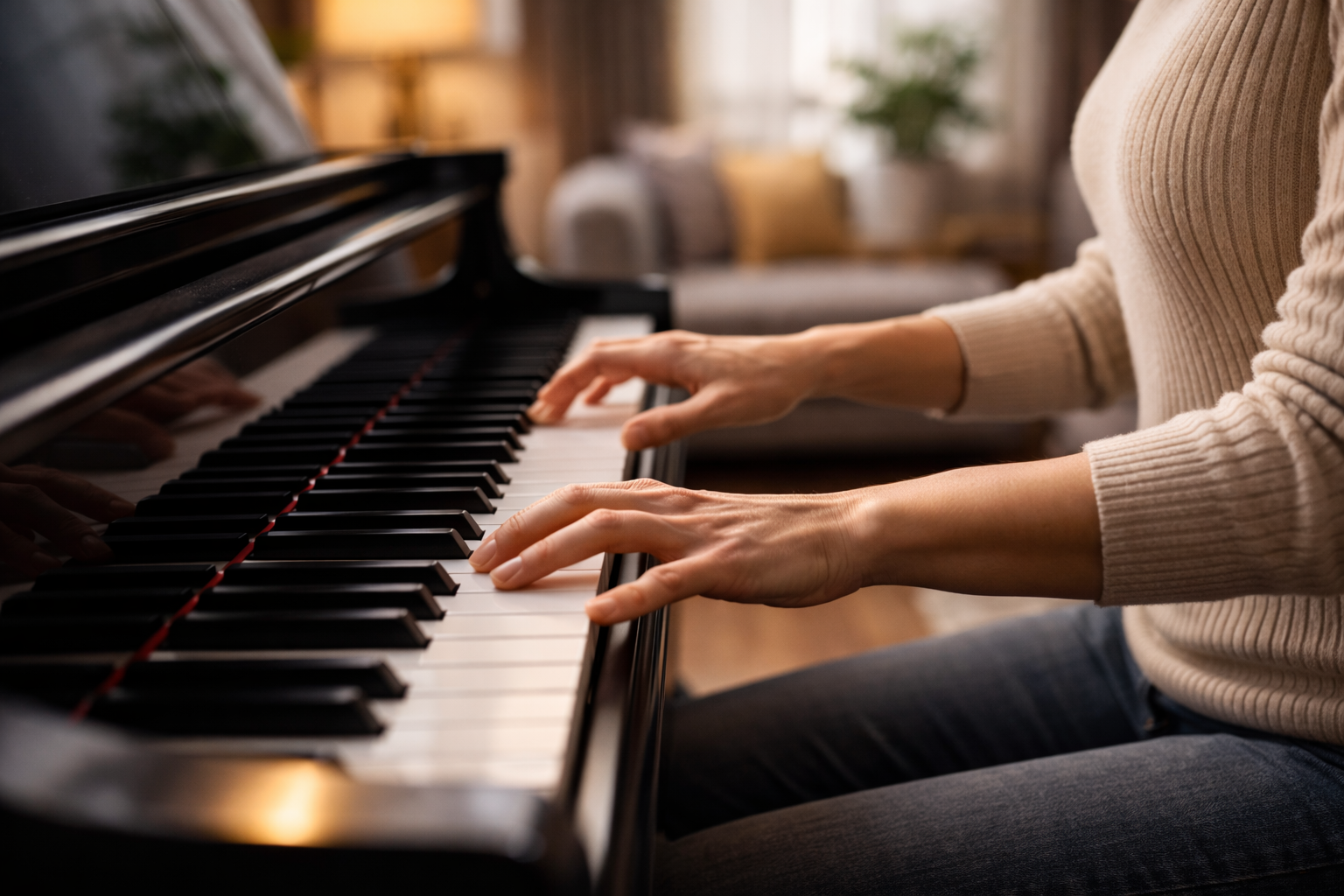
One of the most frustrating challenges adult piano learners face is hand independence. Many adults feel confident when playing each hand separately but struggle the moment both hands need to work together. This difficulty often leads to discouragement and the belief that coordination is something you either have or do not.
In reality, hand independence is not a talent. It is a trainable skill that improves through structured practice and realistic expectations. This guide explains how adult learners can develop strong hand independence step by step without stress or confusion.
Why Hand Independence Feels Harder for Adults
Adults often bring mental habits from daily life into piano practice. We are used to focusing on one task at a time. Piano playing requires splitting attention between two independent actions.
Another reason is expectation. Adults expect coordination to appear quickly. When it does not, frustration follows. Children often accept slow progress more easily, while adults tend to judge themselves.
Understanding that hand independence develops gradually removes unnecessary pressure.
What Hand Independence Actually Means
Hand independence does not mean each hand operates without awareness of the other. It means both hands can perform different roles while remaining coordinated within the same musical structure.
For example:
One hand plays rhythm while the other plays melody
One hand holds chords while the other moves freely
One hand plays legato while the other plays staccato
True independence grows from understanding musical roles rather than mechanical separation.
Start With Hands Separate Every Time
One of the most important principles is always starting hands separate.
Even advanced pianists isolate hands when learning new music. Adults sometimes skip this step to save time, but it usually leads to slower progress.
Hands separate practice allows you to:
Build confidence
Understand each part clearly
Reduce cognitive load
Identify problem areas early
Once each hand feels comfortable, combining them becomes significantly easier.
Slow Practice Is Non Negotiable
Speed hides problems. Slow practice reveals them.
When practicing hands together, slow tempo is essential. Slow playing allows the brain to coordinate movement intentionally.
Playing slowly:
Improves accuracy
Reduces tension
Strengthens rhythm
Builds reliable muscle memory
Adults often resist slow practice because it feels unproductive. In reality, it is the fastest path to coordination.
Simplify One Hand to Free the Other
A powerful strategy for adult learners is simplifying one hand while focusing on the other.
For example:
Play block chords instead of broken chords
Hold bass notes instead of complex patterns
Reduce rhythmic complexity temporarily
This approach allows the brain to focus on coordination without overload. Complexity can be added gradually.
Understanding Vertical Alignment in Music
Reading both hands together becomes easier when adults learn to see vertical alignment.
Vertical alignment means recognizing which notes in each hand occur at the same time.
Instead of reading left to right continuously, train your eyes to scan vertically at key moments. This improves coordination and timing.
Marking alignment points in sheet music can be extremely helpful.
Counting Out Loud and Internal Pulse
Rhythm plays a major role in hand independence.
Counting out loud reinforces timing and coordination. It keeps both hands anchored to the same rhythmic framework.
Even when counting feels uncomfortable, it significantly improves hand synchronization.
Developing an internal pulse is essential. Without it, hands tend to drift apart rhythmically.
Repetition With Awareness Not Force
Repetition builds coordination only when done correctly.
Mindless repetition reinforces mistakes. Conscious repetition reinforces control.
Each repetition should focus on:
Accuracy
Relaxation
Consistent rhythm
Balanced sound
Stop immediately if tension appears. Reset before continuing.
Why Adults Should Avoid Over Complicated Exercises
Some exercises claim to rapidly improve hand independence by introducing extreme complexity. These often overwhelm adult learners and slow progress.
Effective coordination exercises are simple and musical.
Examples include:
Simple scale patterns
Contrary motion scales
Chord melody coordination
Basic rhythmic variation
Complexity should increase gradually, not suddenly.
Mental Practice Away From the Piano
Adults have strong visualization skills. Mental practice can significantly improve hand independence.
Mentally rehearse:
Which hand plays what
Rhythm patterns
Finger movement sequences
Even imagining playing improves coordination when combined with physical practice.
Training Independence Through Repertoire Choice
Choosing the right pieces accelerates coordination development.
Pieces with clear hand roles help adults build independence safely. Avoid repertoire that demands extreme coordination early.
Gradual increase in complexity builds confidence rather than frustration.
Common Mistakes Adults Make With Hand Independence
Avoid these common mistakes:
Practicing too fast
Skipping hands separate work
Overloading both hands
Ignoring rhythm
Judging progress too harshly
Hand independence grows through patience and repetition, not force.
How Long It Takes to Develop Hand Independence
Adults often want clear timelines.
Basic hand coordination usually improves within weeks of consistent practice. More advanced independence continues developing over months and years.
The first breakthrough is mental clarity rather than physical ability.
Staying Motivated During Coordination Challenges
Coordination struggles often cause discouragement.
Remember:
Difficulty means learning
Slow progress is normal
Everyone struggles with this stage
Celebrate small improvements such as fewer mistakes or smoother transitions.
Integrating Hand Independence Into Daily Practice
Hand independence should be trained regularly but briefly.
Ten to fifteen minutes per session is sufficient when focused.
Include coordination work consistently rather than occasionally.
When Coordination Starts to Feel Natural
Eventually, hand independence becomes automatic. At this stage, attention shifts to musical expression rather than mechanics.
This transition is gradual and often unnoticed until suddenly playing feels easier.
Final Thoughts on Improving Hand Independence as an Adult
Hand independence is one of the most important piano skills adults can develop.
It is not a test of talent but a process of coordination training.
By practicing slowly, simplifying tasks, counting rhythm, and maintaining patience, adult learners can build strong hand independence safely.
Progress may feel slow at times, but consistency always wins.
With the right approach, coordination becomes one of the most rewarding aspects of piano playing.